A Q-switched laser earns its place in a clinic when it does three things: treats high-demand concerns like pigmentation for all skin types, tattoo removal, does so safely on every skin type, and pays for itself without draining margin on per-treatment consumables. The five factors that separate a profitable purchase from an expensive one are wavelengths, all-skin-type safety, treatment versatility, consumable cost, and the support behind the device. This guide walks clinic owners and aesthetic professionals through each factor, then shows what “good” looks like using the Helios III as a worked example.
Choosing a laser is a capital decision that shapes your treatment menu, your patient mix, and your margins for years. It deserves more scrutiny than a spec sheet. Here’s how to evaluate one properly.
What is a Q-switched laser, and what does it treat?
A Q-switched laser is a device that fires extremely short, high-energy pulses of light. Those ultra-fast pulses shatter unwanted pigment — melanin in a pigmented lesion, or ink in a tattoo — into particles small enough for the body to clear naturally, while leaving surrounding tissue largely intact.
In a clinical setting, a Q-switched Nd:YAG laser is one of the most versatile platforms you can own. It commonly treats:
- Pigmentation — melasma, lentigines (sun spots), freckles, post-inflammatory hyperpigmentation (PIH), and dermal lesions such as Ota nevus and Hori nevus.
- Tattoo removal — including multi-colour ink and permanent makeup.
- Carbon laser peels — the “Hollywood Facial,” a no-downtime treatment for oil control, brightening, and overall skin clarity.
- Laser Genesis — addresses generalized erythema, rosacea, fine lines, enlarged pores, skin texture, and minor acne scarring.
- Additional protocols — active acne, nail fungus, lip rejuvenation, and full-face rejuvenation.
That range is the point. A device that treats one concern is a line item; a device that treats a dozen is a practice-builder.
Factor 1: Which wavelengths does your clinic actually need?
Wavelength determines what a laser can treat, because different targets sit at different depths and absorb different colours of light. For a pigmentation-and-tattoo workhorse, dual wavelengths are the standard to look for:
- 1064 nm reaches deeper pigment and dark ink, and is the safer wavelength for darker skin tones.
- 532 nm targets superficial pigment — sun spots, freckles — and red and orange tattoo inks.
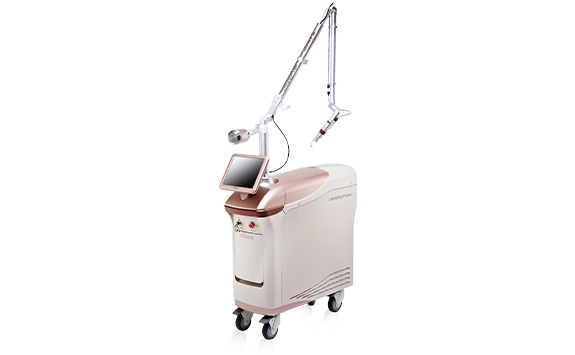
A single-wavelength device limits your menu. A dual-wavelength Nd:YAG platform like Helios III (1064 and 532 nm) covers both surface and deep targets, which is what lets one machine address the full spread of pigment concerns and multi-colour tattoos rather than a narrow slice.
Factor 2: Why does all-skin-type safety expand your revenue?
This is the factor clinics most often underweight. A laser that only performs safely on lighter skin locks you out of a large and growing share of patients — and the ones you turn away don’t come back.
The risk with darker skin tones is that the laser’s energy is absorbed by the skin’s own melanin as well as the target, which can cause burns, or paradoxically more pigmentation. The solution is stable, uniform energy delivery and gentler thermal profiles.
Helios III addresses this with proprietary engineering — a Thermal Lens Compensator and DOE beam technology for uniform energy, plus a Real Twin Pulse (RTP) mode that delivers deeper absorption with milder heat. The practical result is comfortable, safer treatment across all skin tones. For a clinic, that isn’t just a safety feature; it’s a larger addressable patient base and fewer declined consultations.
Factor 3: How many treatments can one laser add to your menu?
Utilization is the single biggest driver of laser ROI, and versatility drives utilization. The more distinct, in-demand treatments a device performs, the more hours it’s booked and the faster it pays back.
Look for a platform with multiple handpieces and operating modes, because that’s what unlocks range. Helios III, for instance, offers four precision handpieces and five treatment modes (1064, 532, 1064 RTP, 532 RTP, and Free Running), letting a provider tailor protocols by depth, target, and skin type — and reduce the number of sessions per outcome.
The strategic layer: a versatile laser lets you stack a repeat-visit engine (pigmentation and tattoo courses require multiple sessions) on top of a fast-glow acquisition offer (the Carbon Laser Peel is photogenic, no-downtime, and social-media friendly, which brings new patients through the door). One is retention; the other is acquisition. The same device funds both.
Factor 4: Consumables vs. no consumables — what it means for ROI
Aesthetic devices split into two economic models, and the difference is fundamental to your margin.
Consumable-based devices require a proprietary component for every treatment, which sets a fixed cost per session and creates a recurring supply dependency. That model has its own advantages — predictable, forecastable margin — but it means every treatment carries a cost.
Many Q-switched lasers, including Helios III, carry no per-treatment consumables. Once the capital cost is covered, the marginal cost of each additional treatment is close to zero. For high-volume, repeat-session treatments like pigmentation and tattoo courses, that structure compounds: every incremental session is almost entirely margin.
When you model the two, the calculation differs:
- Consumable device: margin per treatment = price − consumable cost (fixed, recurring).
- No-consumable laser: margin per treatment ≈ full price after payback, with maintenance rather than per-use cost.
Neither is universally better — but for a device built on high-frequency, multi-session treatments, the no-consumable model is a powerful margin engine.
Factor 5: What about training, support, and compliance?
A laser is only as good as the results your team can safely produce with it, and only as sellable as its regulatory standing. Before you buy, confirm:
- Regulatory licensing. In Canada, look for Health Canada licensing. Helios III is Health Canada licensed, which protects the clinic and reassures patients.
- An authorized, supported supply. Buying through the authorized distributor means genuine equipment, warranty, and a real support relationship — not grey-market risk. DermaSpark is the exclusive Canadian distributor for Helios III.
- Training and clinical resources. Protocol training, before-and-after references, and clinical support shorten the ramp to profitable treatments and reduce the risk of adverse outcomes.
- Manufacturer pedigree. Helios III is engineered and built in-house by Laseroptek, a Korean medi-aesthetic laser specialist — relevant for long-term parts, service, and device stability.
How do you calculate payback on a laser?
Work it in this order (use your own local pricing — these are the mechanics, not quoted figures):
- Revenue per treatment at your market’s rate, per concern.
- Cost per treatment — near zero for a no-consumable laser, plus a maintenance reserve.
- Gross margin per treatment = revenue − cost.
- Break-even volume = device capital cost ÷ gross margin per treatment.
- Payback period = break-even volume ÷ your realistic monthly treatment volume.
- Steady-state profit — after payback, near-full-price margin on every session, across a versatile menu that keeps the device booked.
A versatile, all-skin-type, no-consumable laser tends to reach payback quickly because it stays booked across more concerns and more patients — then produces high-margin recurring revenue.
The bottom line for clinic owners
Judge a Q-switched laser on five things: the right dual wavelengths, genuine all-skin-type safety, a versatile treatment menu, a favourable consumable model, and the support and licensing behind it. A device that clears all five — as Helios III is built to — isn’t just equipment. It’s a profitable, low-maintenance service line that grows your patient base and compounds margin over time.
To see the full treatment range, handpieces, and clinical before-and-afters, view the Helios III Q-Switched laser or book a demo with a DermaSpark expert.
Frequently asked questions
What can a Q-switched Nd:YAG laser treat? A Q-switched Nd:YAG laser treats pigmentation (melasma, sun spots, freckles, PIH, and dermal lesions like Ota and Hori nevus), multi-colour tattoos and permanent makeup, carbon laser peels, and additional concerns such as active acne and nail fungus — making it one of the most versatile devices a clinic can own.
Is a Q-switched laser safe for all skin types? It can be, but only with the right engineering. Stable, uniform energy delivery and gentler thermal modes — such as Helios III’s Real Twin Pulse — allow safe, comfortable treatment on darker skin tones, where less-controlled lasers carry a higher risk of burns or post-inflammatory pigmentation.
Do Q-switched lasers require consumables? Many, including Helios III, have no per-treatment consumables. After the capital cost is recovered, the marginal cost per treatment is minimal, which makes high-volume, multi-session treatments especially profitable. Devices do require routine maintenance over their service life.
Which wavelengths should a pigmentation and tattoo laser have? Dual wavelengths of 1064 nm and 532 nm are the standard. The 1064 nm wavelength reaches deep pigment and dark ink and is safer on darker skin; 532 nm targets superficial pigment and red and orange inks.
Is the Helios III licensed in Canada? Yes. Helios III is Health Canada licensed and distributed exclusively in Canada by DermaSpark, which provides genuine equipment, warranty, training, and clinical support.
How fast does a laser pay for itself? Payback depends on your pricing and utilization. A versatile, all-skin-type, no-consumable laser typically reaches payback faster because it stays booked across more concerns and patients, then delivers high-margin recurring revenue on every subsequent session.